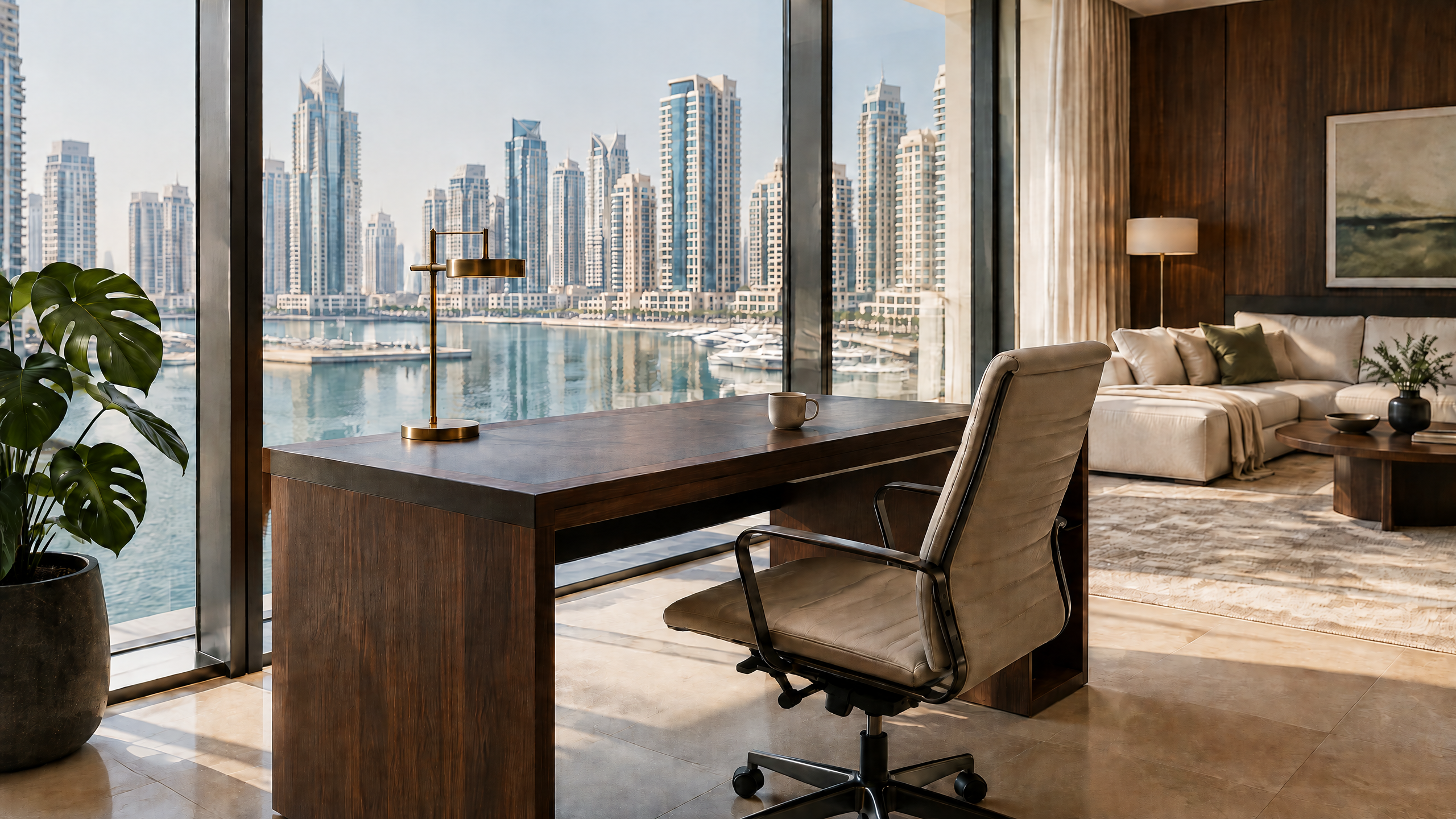
Work-ready should describe the stay, not just the photograph
A desk beside a Dubai skyline can look persuasive in a listing photograph. For someone working during a stay, however, the practical questions arrive later: can they join a call from that chair, plug in equipment comfortably, work without blocking the dining area and get help if the connection fails? An owner should be able to answer those questions before describing a holiday home as work-ready.
Dubai’s official virtual-work programme makes remote-working residents a relevant accommodation use case. It does not establish how many guests will book your unit or what they will pay. Airbnb’s primary-source guidance offers a more property-specific starting point: verify the connection, provide a usable workspace and describe the amenities accurately. Its workspace article dates from May 2022, so it should not be presented as new evidence of Dubai demand in 2026.
**BLVD operational analysis:** assess the experience from the actual work seat, not from the strongest signal beside the router or the most attractive camera angle. This guide gives owners a readiness process, not an occupancy forecast. Our Dubai holiday-home property management overview explains the broader operating scope; the question here is whether this particular home can support the claims made about working there.
Keep residence eligibility separate from accommodation readiness
The General Directorate of Residency and Foreigners Affairs Dubai describes a virtual-work residence permit for a foreigner working remotely for an organisation outside the country. Its service page states a one-year period, subject to renewal, without a domestic guarantor or host. Invest in Dubai’s official programme guide also describes the route and says that applying does not guarantee residence approval.
That is useful context, not a booking promise. A residence permit’s duration is not evidence that a specific holiday home may be booked continuously for the same period, or that every working visitor qualifies for that programme. Invest in Dubai also says the visa does not give the right to work for Dubai or UAE companies; owners should direct immigration questions to the official authorities rather than assess eligibility themselves.
DET’s separate holiday-home service says apartments and villas must be registered and approved before listing. Marketing to remote workers does not replace that requirement. **BLVD operational analysis:** separate guest questions about connectivity and workspace from questions about immigration, the operating permit or a proposed extended booking. Have the operator confirm the appropriate accommodation arrangements for the actual stay. Do not advertise “visa included,” automatic approval or a residence solution that the property team cannot provide.
Test the connection you will actually offer
Airbnb’s “Testing your wifi speed” page says its test is available through the iOS or Android app, with the host at the property and connected to the network listed for guests. It says a result of 50 Mbps or above receives a fast-Wi-Fi highlight. That platform label is not a universal specification for every employer’s systems, a guarantee of uninterrupted video calls or proof of performance from every room.
The same page describes download-speed measurement and explains that results vary with equipment, network activity and testing-server location. Hosts are responsible for ensuring the displayed speed is accurate, representative and available throughout the listing. A broadband package’s advertised speed should therefore not be substituted for observations on the guest network.
**BLVD operational analysis:** record checks from the advertised work seat and other rooms where guests may reasonably work. Repeat under different times and ordinary household activity rather than relying on a single ideal reading. If you also assess upload performance or call stability, identify those as separate checks instead of implying the displayed Airbnb result verifies them. Read the test’s privacy disclosure first: Airbnb says Measurement Lab receives network details, including the IP address, and makes results available for research. Use authorised access and a suitably informed tester; no speed test has been performed on your property for this article.
Sit at the workspace before selecting the amenity
Airbnb’s remote-worker guidance says that a dedicated workspace amenity requires a table or desk used just for work, access to a power outlet and a comfortable chair. A dining table used for meals is not automatically equivalent to the dedicated area described in that guidance. If the home only offers a flexible dining setup, describe that arrangement plainly and recheck the current amenity definition before selecting it.
Sit at the actual chair with a laptop and the equipment the listing promises. Check legroom, the reach to a safe socket, lighting and whether the surface allows ordinary use without moving decorative objects or obstructing a walkway. A photograph should show the chair, surface and room relationship, not hide a cramped corner behind a close crop.
**BLVD operational analysis:** if you propose capacity for more than one working guest, verify the separate seating and surfaces rather than counting bedrooms as workspaces. A second laptop on the same small desk may not suit simultaneous calls. Consider modest changes first, such as a more suitable chair or task light. Our holiday-home interior design service can support a layout discussion, but the purpose should be usable space, not an assumed increase in rental income.
Describe privacy, light and noise honestly
Airbnb’s workspace article suggests good lighting and textiles that soften distractions, along with photographs and captions explaining the setup. These are useful starting points, not evidence that curtains or a rug make a room soundproof. A living-room desk, an enclosed study and a workspace in a bedroom offer different levels of separation, particularly when guests share the home.
**BLVD operational analysis:** check the room at the times working guests are likely to use it. Look for screen glare, direct sunlight, cooling comfort and interference from ordinary household movement. Observe external noise that can reasonably be checked, including building works or common-area activity, and disclose material known limitations. A team cannot guarantee silence across a city or control future construction by neighbouring properties.
Use descriptions that guests can interpret: “desk in the living room beside the window” is clearer than an unqualified “private office” when there is no separate room. Show blinds or curtains and any relevant door in the photographs. Avoid claiming suitability for confidential calls just because a room has a pleasant backdrop. Guests decide whether the arrangement meets their own work requirements; an owner’s job is to make the physical setup and known constraints understandable.
Plan support around someone who may be working
A working guest may need practical information before arrival: which network to use, where the desk is, what equipment is actually included and how to reach support. Airbnb’s Wi-Fi guidance asks hosts to supply the exact details needed to connect, including case-sensitive characters. Keep those instructions in the appropriate guest-access channel rather than placing passwords in publicly visible listing photographs.
**BLVD operational analysis:** nominate a contact for a connection fault and document the escalation route to the account holder, internet provider or authorised technician. Record what the team can troubleshoot and what requires an appointment. A support process is more credible than a claim that a remote worker will never experience an outage. Do not promise a backup connection or replacement workspace unless it is genuinely available under clear arrangements.
For a proposed longer stay, discuss cleaning and planned maintenance access in advance so routine visits do not unexpectedly interrupt calls. Confirm the agreed accommodation terms with the operator rather than treating the guest’s work schedule as permission to change them. Collect only operational preferences needed to deliver the stay; there is no need to gather an employer’s confidential systems information or store details of the guest’s meetings to demonstrate good service.
Use a claim-and-evidence checklist before editing the listing
BLVD’s proposed readiness review connects each marketing statement with something the owner or manager can demonstrate. It is an operating checklist, not an official certification or a claim that a property has already passed a BLVD inspection.
**Connectivity:** retain the test date, network and locations checked, with observed results and any known weak areas. Resolve significant mismatches before promoting coverage throughout the home. Airbnb places responsibility for representative speed claims on the host.
**Workspace:** record the actual desk or table, chair, socket access and room location. If two separate work areas are advertised, show both. Describe a shared or dual-use area honestly and only select amenities the current platform definition supports.
**Comfort and limitations:** show lighting and privacy arrangements and note known material noise or maintenance constraints. Do not turn a brief observation into a guarantee of quiet.
**Service:** identify who handles an internet issue, what equipment is supplied and how planned access is communicated. Check that the guest instructions match the unit’s current setup.
**Listing language:** use an evidence-led description such as “dedicated desk and comfortable chair in the living room; tested Wi-Fi results shown in the amenities.” Add a specific measurement only after testing that property. Do not copy a speed or feature from a neighbouring unit, a service provider’s package or this article’s examples.
Choose readiness improvements before making demand assumptions
A useful owner question is: “What could a working guest verify from our listing, and what would they only discover after arrival?” Address those gaps before making expensive changes or offering a new category of stay. A unit may need only clearer photographs and support instructions; another may need connectivity work or a more functional surface. Some layouts may simply be unsuitable for the claims originally proposed.
Dubai’s official virtual-work guidance establishes a residence pathway, while Airbnb documents its Wi-Fi tool and workspace suggestions. BLVD’s decision to combine them into a unit-level readiness check is our operational analysis. These sources do not support a promised occupancy uplift, rental premium or investment return. Review actual enquiry themes and guest feedback if you test the positioning, without attributing every booking change to a desk or amenity label.
If you would like to assess how an existing Dubai holiday home could accommodate working guests, contact BLVD for a property-readiness conversation. Start with the area, room layout and current management arrangement. A review can clarify what to verify and which claims to avoid; it does not guarantee bookings or immigration approval. Property-specific legal, financial, tax, investment or immigration questions should go to the appropriate qualified adviser or official authority.
Research sources
Sources reviewed for this article
- Issuance of the virtual work residence permit — General Directorate of Residency and Foreigners Affairs Dubai
- Work remotely from Dubai — Invest in Dubai — Dubai Department of Economy and Tourism
- Testing your wifi speed — Airbnb Help Center
- How to make your space comfortable for remote workers — Airbnb Resource Center (11 May 2022)
- Apply for a holiday home permit — Dubai Department of Economy and Tourism